
Summary
The article explains WordPress GDPR compliance. It defines what GDPR is and why WordPress sites must follow its data protection rules.
It also highlights key steps like consent banners, privacy policies, data handling practices, and compliance tools. Helping readers make their WordPress site GDPR-friendly and legally compliant.
Are you collecting emails, using cookies, running analytics, or accepting form submissions on your WordPress website?
If yes, you could be handling personal data without even realizing it, and that can put your site at risk of GDPR non-compliance.
Many WordPress site owners assume GDPR only applies to large businesses or EU-based companies. In reality, even a simple blog or small business website can fall under GDPR if it collects or processes data from EU visitors. Failing to comply can lead to legal issues, loss of user trust, and potential penalties.
This guide is for WordPress beginners, bloggers, businesses, and developers who want to understand GDPR without legal jargon.
In this article, you’ll learn what GDPR means for WordPress, common compliance challenges, and the practical steps you can take to make your WordPress website GDPR-compliant with confidence.
What is GDPR?
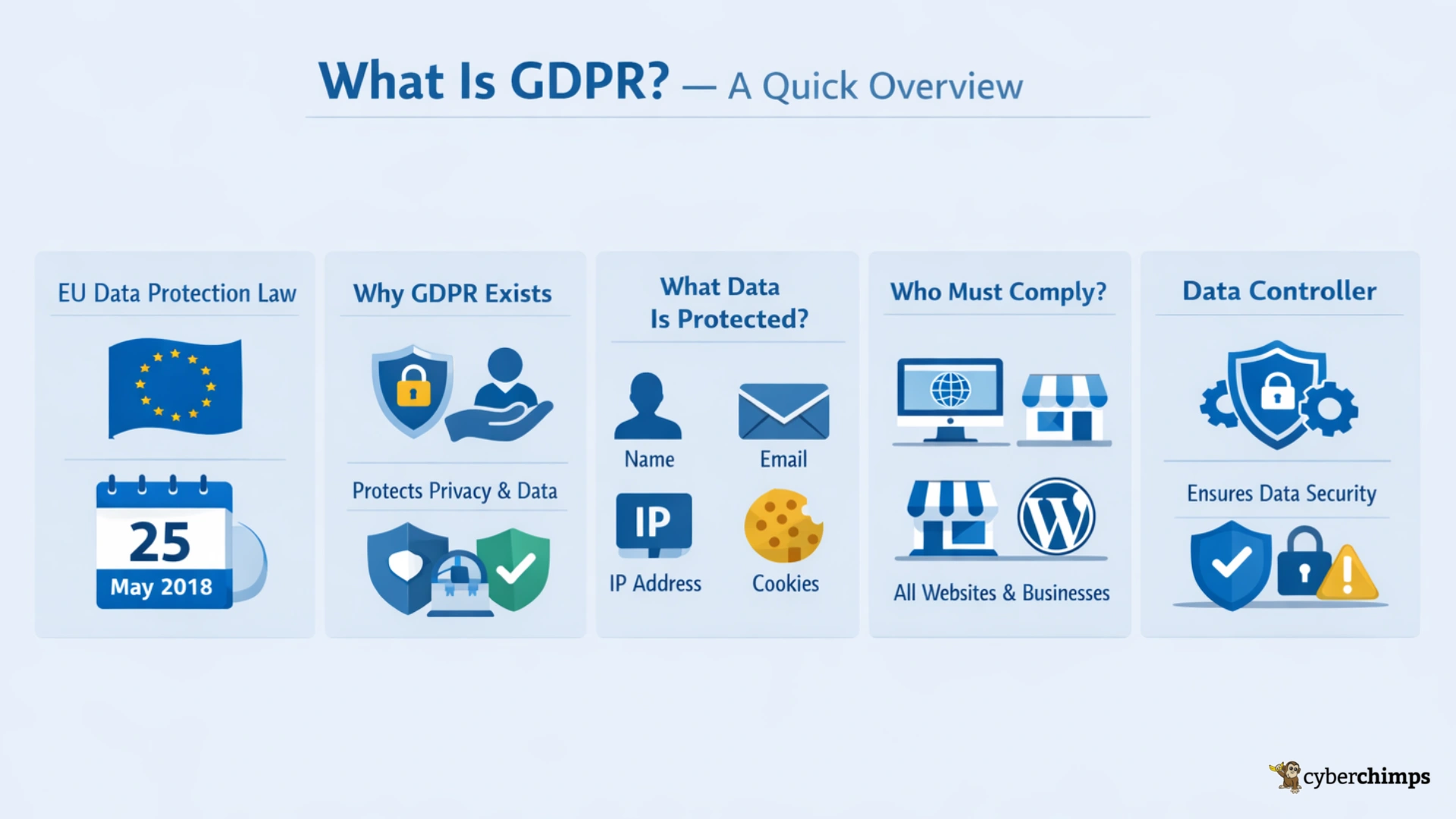
GDPR stands for the General Data Protection Regulation, a comprehensive data protection law enacted by the European Union (EU) and effective from 25 May 2018. It establishes strict rules governing the collection, use, storage, and protection of personal data.
The official legal text of GDPR is available on gdpr-info.eu, which presents all GDPR articles and recitals in a clear, well-structured, and easy-to-navigate format.
GDPR sets out a framework of rules that individuals, organizations, and businesses must follow to ensure the responsible handling of personal data. Its primary objective is to protect the personal data of EU citizens from misuse, unauthorized access, and unlawful processing.
Any organization that collects or stores personal data is required to implement appropriate safeguards to protect it from threats such as data breaches, theft, alteration, or loss. One of the most effective ways to achieve this is by maintaining a GDPR-compliant website, which helps reduce the risk of external or internal data misuse.
From a technical standpoint, any website that collects personal data such as names, email addresses, IP addresses, or cookies is considered a data controller under GDPR. The responsibility for securing this data and ensuring full GDPR compliance rests with the data controller.
Here is a small video that gives a brief introduction to GDPR:

Why GDPR Matters for WordPress Websites
Even if a WordPress site doesn’t run from Europe, GDPR can still apply. Here’s how and why it matters:
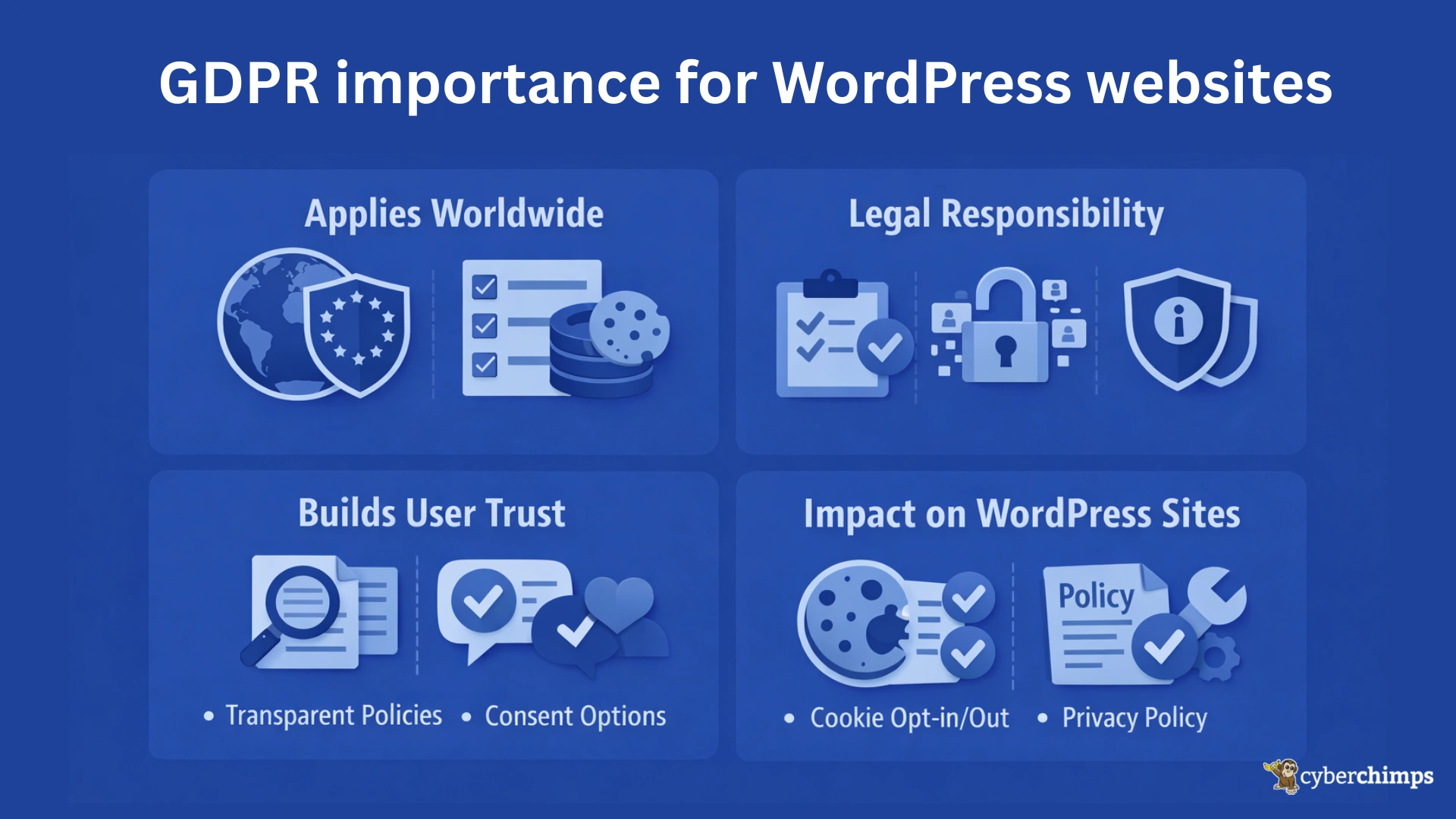
1. GDPR Can Apply Worldwide
If your WordPress site collects or processes personal data about visitors in the EU, GDPR rules apply regardless of where your business is based. This includes simple contact forms, cookies, analytics, or email signups that capture data from EU residents.
2. Legal Obligations
Under GDPR, site owners are legally required to:
- Get clear consent before collecting personal data
- Let users access, delete, or export their data
- Explain clearly how data is used (e.g., via a privacy policy)
- Handle personal data securely and lawfully
Failing to comply can expose site owners to significant fines (up to €20 million or 4 % of global annual revenue) and legal action from users or regulators.
3. Building Trust With Users
GDPR compliance isn’t just a legal box to tick – it helps demonstrate respect for privacy. Clear notices, permission dialogs, and transparent privacy practices give visitors more confidence and can improve engagement and conversion rates.
4. How GDPR Affects WordPress
WordPress sites typically collect personal data (even basic things like usernames, comments, email addresses, or IP addresses). GDPR influences several technical and administrative aspects of running your WordPress site:
- You must offer ways for users to opt in or opt out of cookies and tracking.
- You should publish a clear privacy policy.
- WordPress tools and plugins often include features to help with compliance, such as consent banners or data export tools.
What are the Requirements to make a Website GDPR Compliant?
The aim of GDPR compliance is to give protection to the users. The protection is from information sharing and holding data controllers accountable. For how they collect, store, and use this personal data.
The GDPR regulations are 200 pages long. Here we highlight the key requirements that you should know about:
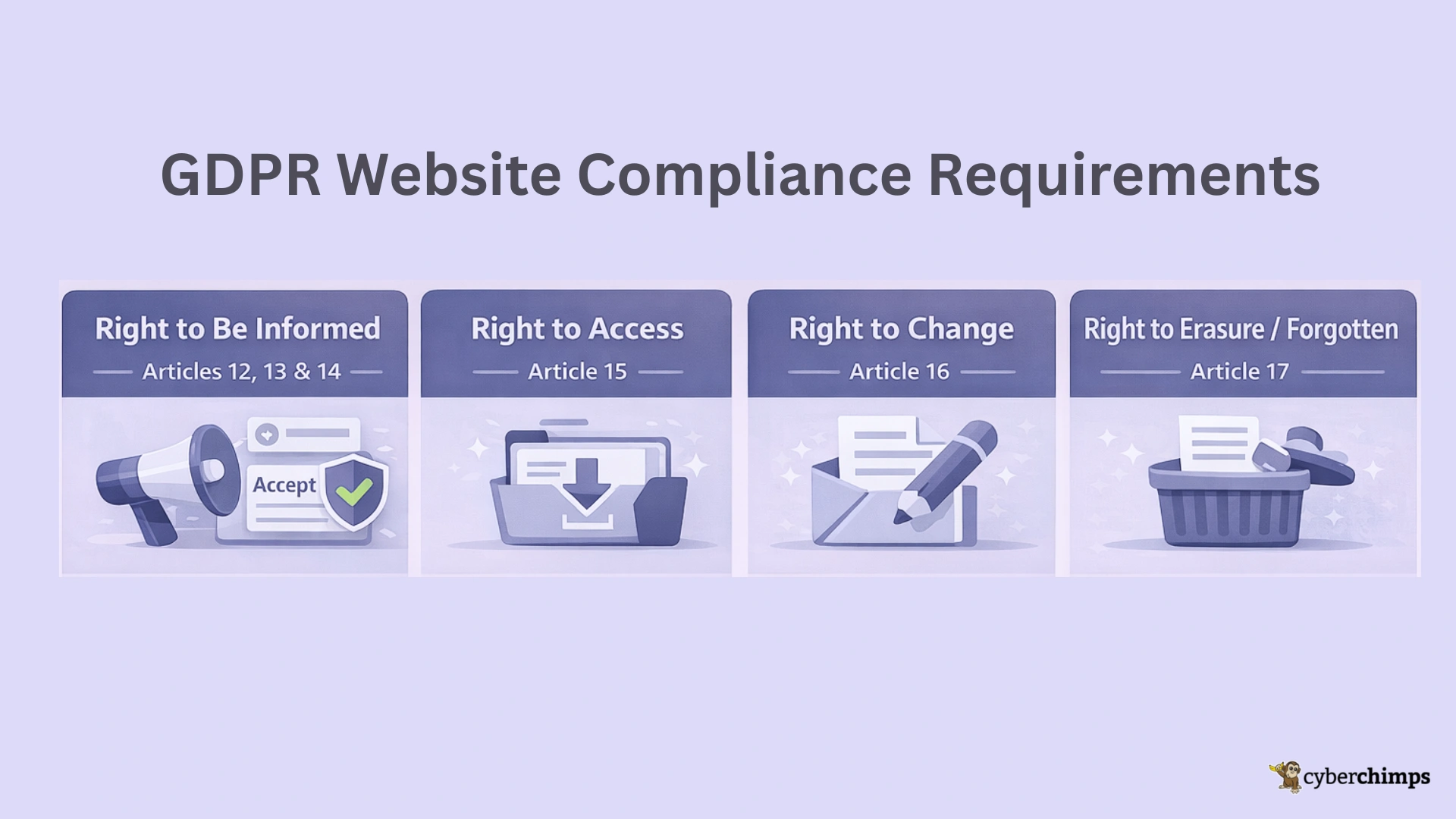
1. Right to be Informed: Under Articles 12,13 & 14 GDPR
Often, you see the “Accept Cookies” notification while accessing a website. The website is asking for your permission to collect your personal data. Also, the websites inform the visitor about information collection. They are also told how this information is accessed and stored.
The website owner shares where the acquired information is liable for usage. The motive is to make the visitor a better judge of accessing or not accessing the account.
2. Right to Access: Under Article 15 of the GDPR
The right to access gives every user the freedom to download their data. You can do this via an electronic copy that must be provided by the owner of the WordPress website, free of charge.
3. Right to Change: Under Article 16 of the GDPR
Rectification of the collected personal data is an equally important condition. This is the responsibility of the controller of the website. However, it is the individual’s duty to have it changed. You have to inform the data controller of any changes or edits without any delay.
4. Right to Erasure/Forgotten: Under Article 17 of the GDPR
All the citizens of the EU have a right to edit or omit their data. They also have the right to get it deleted from the controller’s database completely.
The clause aims to restrict the use of personal information for marketing or any other purpose.
All these rights are covered by WordPress’s GDPR Privacy Policy.
The websites that run through WordPress have to follow them. Apart from this, even the websites that are not operated by WordPress are. They are also liable to follow these regulations.
Who does GDPR impact?
GDPR is pan-EU legislation. It applies to every WordPress website that collects data of EU citizens. Irrespective of being inside or outside of the EU.
If you don’t want to dive into the 39-page GDPR consent guide, we’ve highlighted the 4 major sectors it impacts.
1. WordPress Blogs for Newsletter Subscription.
If your newsletter blog asks the readers for their email addresses and other details, you fall under the purview of WP GDPR compliance rules. Email address, name, address, location, cookie data, and health information is personal data.
This data is dictated by the European Commission’s Data Protection. Monthly income, religion, and identity also come under its purview.
2. WordPress Community Sites for Collection User Profile.
Community sites include forums, social networking sites, and shared blogs. The BuddyPress plugin in WordPress is a tool to build community websites. Even the plugins come under the WordPress GDPR Compliance rules & regulations.
3. WordPress Themes and Plugins Marketplace for Signup.
WordPress has its own portfolio of themes and plugins. They help develop a bespoke website. These tweaks and additions need the inclusion of themes and a few other plugins. They are installed on the WordPress backend for better functioning.
Any user looking to use WP themes and plugins has to create an account and fill in their personal information. The data controller collects and stores this information. Hence, the GDPR regulations also have an impact on the plugins and themes.
4. WooCommerce stores for Selling Products.
To provide more information and visibility to EU residents, all e-commerce websites used by citizens must become GDPR-compliant.
Non-compliance with these rules will invite penalties. It won’t matter where the website originates, whether it is inside or outside the territorial boundaries of the EU. If your WooCommerce website sells to an EU citizen, GDPR follows.
What Happens If Your WordPress Site Is Not GDPR Compliant?
Failing to make your WordPress website GDPR compliant can lead to serious legal, financial, and reputational consequences. GDPR is not just a guideline it is a legally enforceable regulation, and non-compliance can expose your site to multiple risks.
- Heavy Fines and Legal Penalties: Regulatory authorities can impose fines of up to €20 million or 4% of annual global turnover, whichever is higher. Even smaller businesses and individual site owners are not exempt if they violate GDPR requirements.
- Legal Complaints and Investigations: Users have the right to file complaints if their personal data is misused or collected without proper consent. This can trigger investigations by data protection authorities, leading to audits and enforcement actions.
- Loss of User Trust: Privacy is a major concern for online users. A non-compliant website can damage your credibility, reduce user confidence, and negatively impact conversions, subscriptions, and customer loyalty.
- Risk of Data Breaches: Without proper GDPR safeguards, such as consent management, data security, and access controls, your site is more vulnerable to data breaches, leaks, and unauthorized data access.
- Business and Reputation Damage: Non-compliance can result in public penalties, negative publicity, and long-term damage to your brand reputation, making it harder to grow or retain users.
How to Make Your WordPress Site GDPR Compliant?
The last date to make a website GDPR compliant was 25th May 2018. Any website found not in concurrence to these laws and regulations invites a heavy fine.
Being GDPR compliant varies from website to website. In this article, we will highlight some important regulations of GDPR. It also includes some plugins that will help you with relevant compliances.
1. Hire a Lawyer.
GDPR is often called the common child of the IT patrons and legal representatives. The WordPress GDPR Privacy Policy is brimming with legal terms. And processes that are not common for most business and website owners.
As a data controller, you need to understand the consequences of a breach in the data protection laws. There are numerous intricacies in the GDPR guidelines that you, as a businessman, may not understand. A lawyer can help you on a case-by-case basis with GDPR compliance.
2. Review your Data Collection Policy.
The purpose of this review is to ensure transparency. Transparency means that you have to state to the subject or individual.
The type of data you are collecting and the storage location of this data, as well as the reason for collecting personal data, the duration, and the purpose. And finally, you also need to convey your data protection procedures.
Only fulfilling them will make your website become GDPR compliant.
3. Update all Legal Documents.
You must have noticed that now you cannot create a new account on a website unless you tick a checkbox at the end. Well, that checkbox has emerged because of GDPR.
Every website that serves the citizens of the EU has to update all the legal documents on the website. So that they are out there in the public forum and open for the users to read and give their consent.
The legal documents include terms and conditions and privacy policy for the most part. It also includes marketing affiliate terms, account details, and other such documents.
These documents explain to the individual how they can proceed with the GDPR legislation still in force.
4. Self-certify your site under pthe rivacy framework.
Trade websites across the Atlantic are liable to ensure WordPress GDPR compliance. In the wake of making it easy for the websites, the US, EU, and the Swiss Administrations have set up EU-US & Swiss-EU Privacy Shield frameworks.
The purpose of setting up these frameworks is to ensure smooth business transactions. Also, ensuring that small and medium business provides compliance evidence.
5. Encrypt data by moving to HTTPS.
Data encryption is a quintessential part of the new GDPR directives. As a data collector and controller, it is your prerogative to protect the data.
Data encryption is more secure with HTTPS.
In WordPress, you can move from HTTP to HTTPS. With this, you make your website secure and, at the same time, well within the limits of GDPR Compliance.
Plugins to make WordPress site GDPR compliant
Making a WordPress site fully GDPR compliant often requires cookie consent, consent logging, legal pages, and user rights management. While several plugins handle individual aspects, the most effective approach is using an all-in-one compliance solution.
WPLP Compliance Platform Solution:
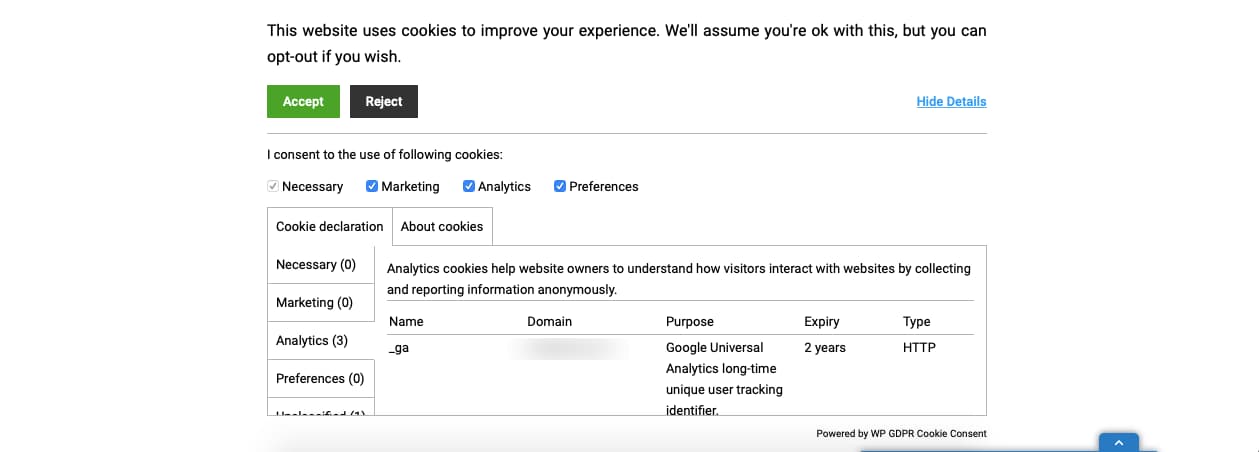
The WPLP Compliance Platform is a complete GDPR compliance solution built specifically for WordPress websites.
It helps you:
- Display GDPR-compliant cookie consent banners
- Log and store user consent records
- Generate and manage GDPR-ready legal pages
- Handle user data requests (access, deletion, export)
- Stay compliant without installing multiple plugins
Instead of combining different tools, WPLP centralizes everything required for GDPR compliance in one dashboard.
GDPR Cookie Compliance:
This plugin is another one of the best WordPress GDPR plugins. That is because of its ability to alter the cookie consent policy and make it specific for every user or visitor. The pro-version of GDPR Cookie Compliance starts at £29.
WP Security Audit Log:
This WordPress GDPR Plugin gives you a detailed log of website activity. It will enlist all the contact forms, checkboxes, and registration columns. Also, WordPress multi-site changes and any other kind of changes. The basic idea is to record everything affecting the final outcome of the website’s WordPress GDPR Compliance. There are three premium packs for WP Security Auto Log, priced at $89, $99, and $149 per year.
FAQ
GDPR (General Data Protection Regulation) is an EU law that governs how personal data must be collected, processed, stored, and protected. If your WordPress site collects or processes data from EU visitors even if your business is outside the EU you must comply with GDPR.
Personal data includes information like names, email addresses, locations, cookie IDs, and other identifiers that relate to an individual.
The article lists GDPR-related plugins that help with compliance tasks such as cookie consent and tracking consent values.
Conclusion
WordPress GDPR Compliance is future-ready legislation. It has secured both the privacy rights of EU citizens and comprehensive security.
The goal is to restrict the use, sale, or tinkering with the personal data of EU subjects. The end user can use the internet without risk of personal information theft.
The impact of the General Data Protection Regulation on WordPress websites is remarkable. Start working to make your website GDPR-compliant immediately.